As someone who forages mushrooms pretty extensively my advice is not to forage psychedelic mushrooms as a beginner. Most psilocybin mushrooms fall into the colloquial category of "LBMs" (little brown mushrooms) and the advice is almost always not to forage LBMs because there a million of them, they all look alike, and you might not know from region to region what the risk of look a likes are. '
So unless you have a region specific guidebook, and can make an absolutely positive identification (which probably involves identifying spores from a print under a microscope for LBMs), you really should not forage LBMs or any mushrooms for that fact. In some cases you might also need to know how to safely taste or smell the mushrooms and then know what you are tasting or smelling for. No beginner is going to be able to do any of that.
Let someone else grow them from a verified strain from a syringe. It's much safer.
As an aside, mushroom foraging is very beginner friendly as long as you stick to the right categories. Things like Chicken of The Woods, oysters, and maitakke are very easy to positively identify and don't have many look alikes in most parts of the US. The often propogated idea that mushroom foraging is only for safe for trained experts is totally untrue. The average person can safely forage for mushrooms. Just buy a region specific guidebook, and stick to the categories that your book tells you are safe for your region.
There's a crazy amount of inertia around the 'mushroom foraging is only for experts' idea. I was just telling my mother in law this weekend that in our area there are no killer mushrooms. There are mushrooms that taste very bad, and (in the worst case) will cause stomach upset (vomiting) but nothing that will kill you outright. I was trying to encourage her to try some of the more well known edible wild varieties (which as the parent comment pointed out are often very easily identified) but she wouldn't budge from the belief that if you're not an expert you'll pick a mushroom and die. People are missing out on a very enjoyable past time because of fear mongering.
> Nicholas - We had this family doctor came around and we knew pretty well actually what they were. I mean, we looked in the book the very next morning when Alastair started feeling ill and Charlotte was already ill. It was so clear from the photograph that what we had eaten, it wasn't a cep. It was themushroom called cortinarius speciosissimus which some people call the deadly webcap apparently. It had a rather comforting skull and cross bones underneath it, with a little caption, deadly poisonous.
Any time someone says "this is xyz 101, how could anyone be so confused", I hear instead "the human capacity for doing something without what others view as 'minimum sufficient education to survive it' remains unchanged throughout human history", which is precisely why the warnings are so dire. It's not to scare people away, it's just to offer them a defense versus their own curiosity and impulsiveness until they choose to make time to learn xyz 101.
Ah! That sounds like a job for an NTSB-type analysis, because most human WTFs are built on a series of improbable events.
Maybe their glasses were fogged? Maybe the afternoon light was at the right angle to hide the 'gills' enough that their check failed? Maybe they had a time-efficient shortcut that finally found an edge case they hadn't planned for?
Right, of people who die from mushroom poisoning, they are almost all either immigrants eating things that look like edible mushrooms where they come from, or else children who are randomly eating things they see in their lawn. Cases like this where you have someone who has been foraging for decades and eats something deadly poisonous happen maybe once every ten years, and I suspect it's mostly people with early onset Parkinson's or something that's causing them to act impulsively. This isn't an identification mistake, there's clearly some kind of neurological issue here.
From the story it doesn't even appear that they attempted an ID until after they were very ill.
Back to the car analogy, if someone kills themself driving down the wrong side of the highway we don't all give up on driving because it is unsafe.
Yes you can definitely kill yourself foraging mushrooms. It's exceptionally unlikely with even a small bit of precaution and common sense but of course if you disregard all of that you are putting yourself at huge risk. Just like almost every other activity that involves some risks.
The article is only about prevalence of P. Sem. (Liberty cap).
In my experience and in a network of many other people, there are precisely ZERO little brown mushrooms having BOTH a passing resemblance to p. sem. in any conditions (dry/wet or young/old) AND are noxious let alone dangerous.
If its your first time, be cautious, take a good book. On a dry day P. Sem. is easier to distinguish from other species that are safe but wrong. One day of successful foraging and you will know P. Sem. well enough in the wet too.
If it has the characteristic nipple, it is certainly what you are looking for. If not,well it may be, but you can just leave it until your skill improves.
Finally, needless to say, the moment the first mushroom enters your mouth, foraging is over for the day.
This advice is only going to be true in your region. If someone picks up a guidebook for your region and it says that they are safe to pick there then I'm all for it
This is exactly why most foraging illnesses happen to travelers because some thing that is true in a specific place is frequently not true in other places.
> There's a crazy amount of inertia around the 'mushroom foraging is only for experts' idea.
Yeah, it's for good reason, when it comes to "LBMs" - little brown mushrooms - of which the Psilocybe genus is largely composed: You can find example photos of Psychoactive species literally growing right next to e.g. Gallerina species, which will nuke your liver.
Well, vomiting isn't very nice either. And some (many?) folks aren't crazy about mushrooms to start with. They may make apologies of the "I wouldn't know how to pick them safely" sort to avoid having to go mushrooming...
Thats undeniably true, vomiting isn't something anyone wants to do. However you're VERY unlikely to pick anything except what you're looking for if you stick to the 'biggies' of the found mushroom world as the grandparent comment covers--chicken of the wood, hen of the wood, morels, etc. They're quite distinctive and not easily confused with other things. The LBMs are a whole different kettle of fish--you're definitely into 'hard mode' when you try to differentiate those. But until you're an expert there's really no reason you'd even be looking for mushrooms in that category.
Hm. Morels around here come in 4 colors, and some of those can resemble other toxic mushrooms that also grow around here.
It can seem 'easy' to distinguish when familiar. But if you're coming at it fresh it's quite daunting. And to make your friends sick is a significant faux pas.
Anyway that leaves the "I don't want to do this, and I want a 'good reason' and the death card is a good reason" cause of reluctance. It may be more common that we think.
Yeah but how hard is it to get a guidebook and figure out if Morels are a safe pick in your area. If you already know morels have look a likes where you are, then don't pick them unless you have put in the time on your own research and feel you know how to make that particular ID.
Especially after I've picked something, it is really easy to move backwards and say "is there uncertainty with what this could be?".
In years of eating foraged mushrooms, I have never gotten so much as a stomach ache.
If you are making educated identifications (which is really easy to do with the materials available in this age) you shouldn't ever be vomiting when eating mushrooms.
A very small percentage of people cannot handle most of the mushrooms that other people can and will vomit but this is true of many other food categories and is not unique to mushrooms.
This is absolutely true. I'm an amateur forager, but try to make it out with the mushroom club once per year to learn more. For me, it started with identifying one mushroom (morels) and the variants that make people sick.
Part of me doesn't mind that people stay afraid, it's less competition for a great time hunting. The other part rolls their eyes at those who don't do educated risk for the reward.
Sadly I think it's fine. Where I live in the PNW there are way to many people mushroom foraging who seem to have little to no idea how to be in the woods. People rake the forest floor, people leave trash, people leave toilet paper, etc. I've actually stopped mushroom foraging in most places because the forest completely over foraged.
In my experience with most outdoor activities the concept of leave no trace is completely lost on people, so unfortunately I'm fine with less people mushroom foraging.
I try and explain the very easy concept of making a spore print to people and they just look at me like "wow you're really smart i don't think i could do that"
...
Right after I just explained how easy it is. Reminds me of explaining password mnemonics to people sometimes. I really don't think a lot of people are prepared for taking basic safety measures and the amount of people getting poisoned in the news is high enough that I feel the alarm is warranted. I remember seeing this one photo of a girl biting an amanita species saying how someone here in Costa Rica said it would get her high and she was explaining how she was in so much pain but was asking on FACEBOOK of all websites if there was any 'natural way' to cure it, like uhh yeah no you need a helicopter to the hospital
People are missing out on a very enjoyable past time because of fear mongering.
It's subjective that people would find it enjoyable. Even
of all the past times one can do, there are similar ones, like birding, hiking, gardening, etc. We're not short on past times that, even in the worst case, won't even leave you vomiting.
OK, I should have said "out there" instead of "up there" -- happy now? It doesn't change my point at all. What happens when you twist your ankle in those uneven woods and are unable to get out before nightfall?
I never said it was "complicated." Don't hike alone, leave a detailed itinerary with others, carry warm overnight clothing just in case, etc. Collect a few of these simple rules in one place and what do you have? A manual.
"There are mushrooms that taste very bad, and (in the worst case) will cause stomach upset (vomiting) but nothing that will kill you outright."
This is false and dangerous misinformation!
Mushrooms can certainly kill you, and people have died from eating poisonous mushrooms.
Just one example, from the Amanita[1] genus:
"Several members of the section Phalloidieae are notable for their toxicity, containing toxins known as amatoxins, which can cause liver failure and death. These include the death cap A. phalloides; species known as destroying angels,
including A. virosa, A. bisporigera and A. ocreata; and the fool's mushroom, A. verna."
"More recently, a series in the subgenus Lepidella has been found to cause acute kidney failure, including A. smithiana of northwestern North America, A. pseudoporphyria of Japan, and A. proxima of southern Europe."
I'm actually kind of skeptical that anywhere exists with no toxic mushrooms. I know in my region there are many. Probably 100+ and at least 5-10 very common ones.
How can we be so certain there are no killer mushrooms in your area? We have no idea what is growing on a daily basis, the guidebooks were only accurate on the date of publication.
This just isn't true. There aren't new mushroom species popping up in the night with any regularity. In the US we have a very good survey of what is out there.
I have never heard a story of someone making a positive identification based on the resources available, then getting poisoned because they had discovered a new species which had total overlap with their positive identification. Doesn't mean it's never happened but I would say if it has it is exceedingly rare.
In the same way we don't not drive because it's possible to crash, I'm not going to stop foraging because of the possibility of super outlier events.
I was talking about misidentifying because there's a mushroom present that 'shouldnt' be in the area, not an entirely new species, lets not get carried away because it frustrated you.
There are plenty of things people dont do because of the risk, so your argument there is complete nonsense.
Sure jumping out of a plane with a parachute is going to be safe if you're confident you know what you're doing, but there's plenty of people (including myself) that wouldn't dare do it.
The comment I responded to had this -
"but she wouldn't budge from the belief that if you're not an expert you'll pick a mushroom and die. People are missing out on a very enjoyable past time because of fear mongering."
Which is an unbelievably ignorant attitude. Comes across as "People aren't getting into X hobby I like because they're afraid, so we should peer pressure them into doing it anyway" (even though someone who is nervous is 10x more likely to make a mistake that DOES end in death or illness)
Suppose you find a mushroom that obviously bruises blue and generally matches the phenotype of whatever local psilocybe grows in your area. What's your risk?
I looked into galerina poisonings, being the most similar mushroom I can think of off the top of my head that might poison you, but there are so, so few cases. Maybe 1 every two years? Given how many people forage for magic mushrooms, I have to wonder if the risk is really there.
Open to having my mind changed. I've been foraging for about 10 years, but this is not something I know a whole lot about, except for that I never hear about it.
> Suppose you find a mushroom that obviously bruises blue and generally matches the phenotype of whatever local psilocybe grows in your area. What's your risk?
If it has chocolate brown spores and bruises blue then the risk is zero in every area that I know of. The only issue people are going to have is not knowing what bluing actually is, and thinking "well maybe this is navy blue" or whatever. Or only looking for bluing on some, but not all of the mushrooms in a collection.
I mean, Im really not advising against foraging psilocybes across the board but I feel like it's the kind of thing where if you have to ask, the answer is no.
For what it's worth, in my region(western PA) gallerinas are anecdotally an order of magnitude more common than any psilocybes. Actually the only psilocybin mushroom I've heard of anyone harvesting around here is gymnopilus sp. This one is also notoriously hard to identify.
I'd encourage anyone interested in this to watch Alan Rockefeller's fantastic talks on psilocybin mushroom identification: [1] [2]
If you do decide to pick your own mushrooms, definitely look for the signs he mentions in the videos, make spore prints, and post pictures of the mushrooms to the sites he recommends, where experts can identify them for you.
And remember: There are old mushroom hunters, and there are bold mushroom hunters. But there are no old, bold mushroom hunters.
Specifically, some species of Psilocybe look almost identical to some Galerina species, and sometimes they grow right next to each other. You don't want to eat Galerina[1].
In my opinion, hunting shelf fungi is pretty beginner friendly. As far as I'm aware, many species are edible, and those that aren't will just give you a stomach ache instead of giving you liver failure.
You can observe for the presence of psilocybin by blue bruising of the mushroom flesh. If you make a tea, the water will turn blue as psilocybin converts into psilocin through hydrolysis. You can squeeze some lemon juice in to stop the reaction before it turns from blue to dark (i.e. adjust the pH to stop the reaction before the psilocin breaks down into non-active compounds).
Or you can just get some 4-Aco-DMT to convert to psilocin which is way easier to microdose.
It is true that afaik, every pislocybe species bruises blue, the problem is, could it bruise blue, contain psilocybin, but also be poisonous. I think the truth is that it is pretty rare for that to be the case or may even be non existent but I'd definitely want to get verification on that for my specific region before harvesting anything.
Also, as a general point, it is a myth that bruising blue always indicates the presence of psilocybin. For instance, many boletes bruise blue and don't contain any psilocybin.
Here's a picture of an intensely blue staining bolete that does not have psilocybin:
Could be a neoboletus luridiformis with an unusually slim stem. In any case, I would say the color saturation in this picture is cranked up quite a bit.
You are probably right that they played with saturation here but I don't think by that much. I've seen boletes that look pretty close to that in person in the 5-10 seconds after you tear them.
Always cook mushrooms, you can taste a little when out foraging to help identify but all mushrooms should be cooked (even lightly) before being consumed as food.
I'd recommend to go on facebook or just on the web and look for a local group related to foraging. Everyone there will know what the best books are for your region because 10 people probably join that group everyday and ask the same question and they will probably have a stock answer.


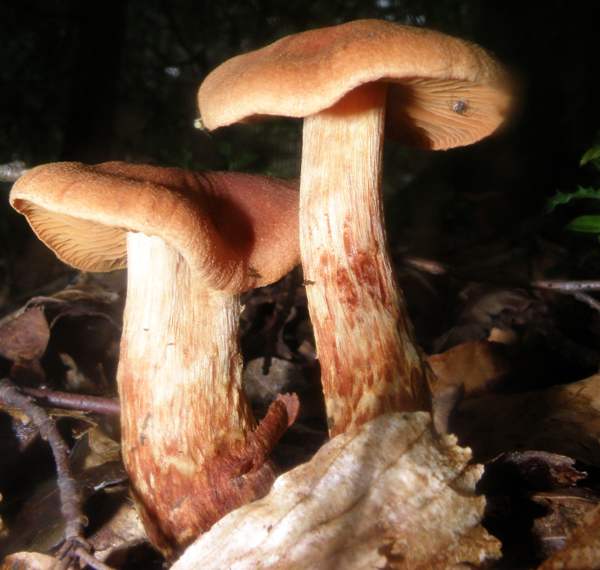


So unless you have a region specific guidebook, and can make an absolutely positive identification (which probably involves identifying spores from a print under a microscope for LBMs), you really should not forage LBMs or any mushrooms for that fact. In some cases you might also need to know how to safely taste or smell the mushrooms and then know what you are tasting or smelling for. No beginner is going to be able to do any of that.
Let someone else grow them from a verified strain from a syringe. It's much safer.
As an aside, mushroom foraging is very beginner friendly as long as you stick to the right categories. Things like Chicken of The Woods, oysters, and maitakke are very easy to positively identify and don't have many look alikes in most parts of the US. The often propogated idea that mushroom foraging is only for safe for trained experts is totally untrue. The average person can safely forage for mushrooms. Just buy a region specific guidebook, and stick to the categories that your book tells you are safe for your region.