I first read this and immediately thought it was ridiculous. After a second read, I'm wondering if there is some deception going on. The idea that a license should be required to make advisement on designs impacting the public is reasonable. While nothing is guaranteed, it allows for a simple verification of skills.
I find it hard to believe that any engineer would not know this because I was told companies and the gov. use PEs to sign off on designs that impact the public when I was getting my degree in mechanical engineering.
The question here is whether this man was truly barred from speaking publicly about engineering or whether he was barred from testifying about engineering.
The former would be a problem due to its broadness, but the second would definitely not be.
> The question here is whether this man was truly barred from speaking publicly about engineering or whether he was barred from testifying about engineering.
I don't think that is the main question, the testify vs speak is secondary. He is not a "Licensed Engineer", but he IS an "Engineer" (Graduated Engineering school, and worked legally his whole life as an Engineer in the subset of "engineering" that doesn't require a license). So he is an expert in "Engineering" (the subset) by schooling and legal work experience, and should be able to provide expert testimony on the field where he is an expert. He is not thou, an expert in "Licensed Engineering", so he can't provide expert testimony on that. The question them becomes: The testimony he gave applies to the subset of engineering that is only allowed to a "Licensed Engineer"? Or in other words, would he be forbidden from working on the thing he is testifying about? If the answer is yes, then he broke the law, by presenting himself as an expert Engineer in a matter restricted to licensed, then he wrongly presented himself as licensed. If the answer is no, if the matter discussed is something he was allowed to work on (before he retired) without a license, then there is nothing wrong with his testimony.
The topic of “unauthorized practice of law” was my favorite in the required legal ethics course because it’s really hard to define. There’s definitely a compelling state interest in preventing just anyone from running around giving people shitty legal advice. Bad legal advice could mean someone serving years, or even a lifetime, in prison. But at the same time the people have a right to discuss the law, how it is (and should be) interpreted, and the implications of those interpretations. It’s maybe even more than a right. It’s arguably a requirement of a functional democracy. If you can’t discuss the law you can’t have a role in shaping it
And balancing those two important interests most states have drawn the line at: you can’t tell (or insinuate to) the public you’re a licensed attorney if you’re not and you can’t file legal documents with a court or a regulator on behalf of someone else unless under the supervision of a licensed attorney.
You can, however, spout your terrible and blatantly wrong legal opinion all over the internet, tv, and in print to anyone willing to listen. No law license required. Many people have even made a career of it.
The judge can decide who gets to testify in his own court, but that doesn't preclude a licensing board from sanctioning the witness as practicing without a license.
>that doesn't preclude a licensing board from sanctioning the witness as practicing without a license
Yes, according to the current law, which is not serving the needs of society well. If an engineer has been working for many years for a company which was not required to have a license, this is already a sufficient proof of qualification and licensing board should not be able to sanction anyone in such case. On the contrary, they should offer a way to obtain a post-factum license either as a result of exam or based on audit of previously implemented projects, and the cost of such license should not be prohibitive, only covering the reasonable share of the expenses of the board.
The purpose of licensing for society is to restrict certain activities only to qualified individuals and businesses to reduce risks of unacceptable damage. This restriction does not imply that a license should be obtained in order to do something, only that there must be a proof of qualification and a license is a sufficient proof. When and how this proof is presented, should not matter, as long as it happens. The law must only create a liability for those people, who cannot present a verifiable proof.
If a court decides HN gets mad and wonders why judges get to determine engineering matters. If an engineering board decides HN gets mad and wonders why engineers have a say in legal matters.
You can waffle with "it's not the same part of HN" or something, but honestly it sounds more like a lot of HN just doesn't like anything which might prevent them from offering their opinion in inappropriate contexts, and their mechanism to avoid this is to refuse to let anyone judge the appropriateness of a context.
Big "what's next, a license to toast" energy from all this tbh.
The „HN gets mad“ generalization is a logical fallacy. Maybe somewhere on some subreddit there is a uniform crowd for which generalization and such meta-comments are ok, but here we have plenty of people who have different opinions, express them and may have disagreements: you cannot put a common label and blame for inconsistency, because you do not have a target for it.
It isn't a logical fallacy. HN has a long history of being against any sort of credentialism. Tell a programmer that he isn't a real engineer in any sense of the word and watch the downvotes flow. Plenty here want titles without effort.
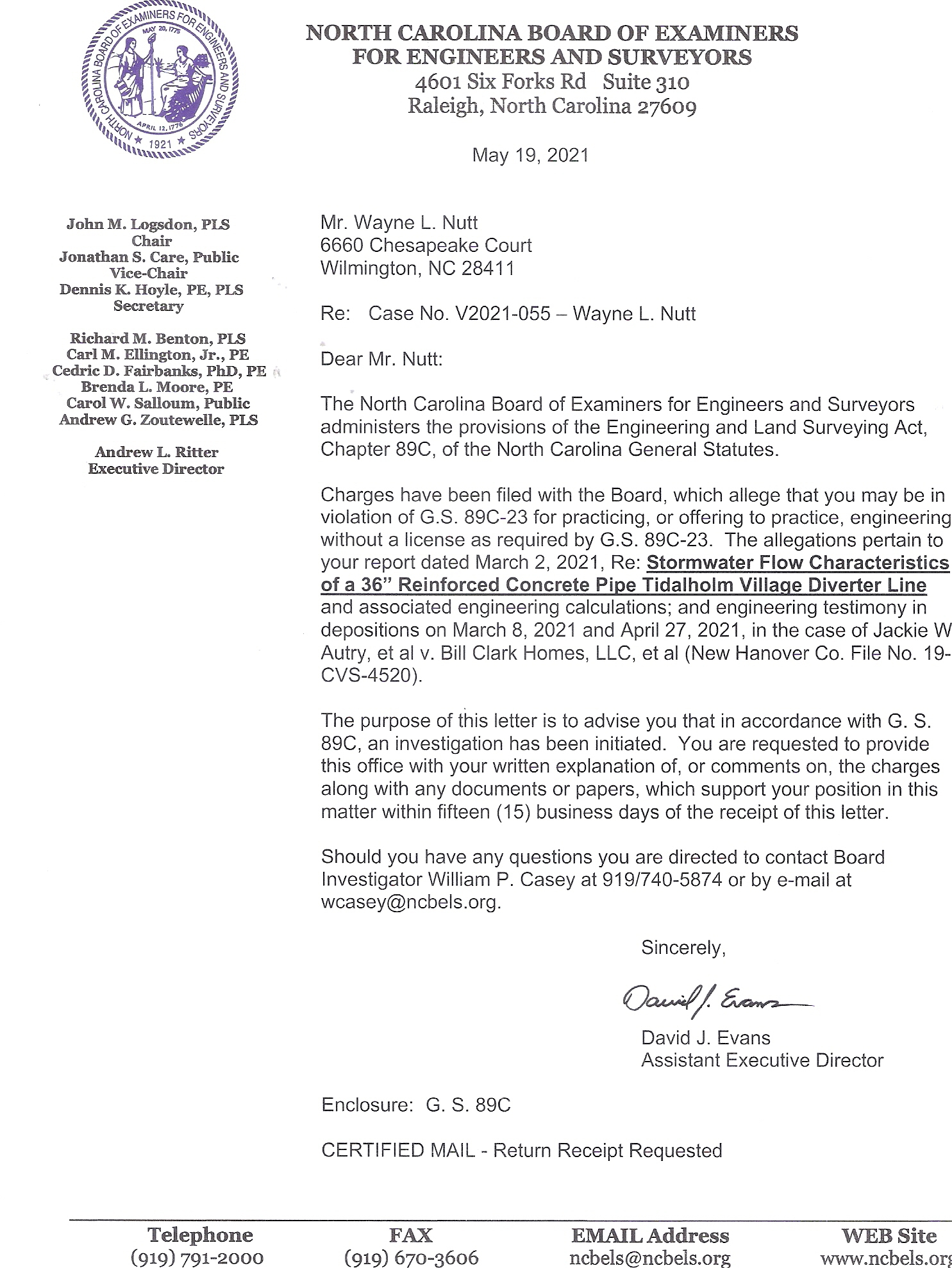
Yeah. The report referenced in that letter seems like the sort of thing that would normally be created or at least signed off by a civil engineering PE. Now, one can stipulate that he was very upfront in the report that he's not a PE and the judge is welcome to judge credibility. But I sort of see where this letter is coming from.
After reading the law, it actually seems to be a clear violation.
He is not a party in the court case so presumably his testimony is that of an expert witness. Providing expert testimony as an engineer sounds an awful lot like practicing engineering. He is not licensed and he is not practicing under the aegis of a licensed firm. He's in violation of the law.
Licensed professions have such things as "reserved acts". This is the issue at hand. Offering legal engineering advice is apparently protected. It's not only that the the judge should dismiss the opinion if presented, it's that even the act of trying to make one in front of a court is possibly illegal. Disclaimers are irrelevant when one is trying to perform such a reserved act, especially if one knowingly does it while ignoring the law.
If he represented himself as an engineer or engineering expert in a legal proceeding, well, that’s where he may have made a mis-step. Even if it’s on behalf of his son.
Maybe, he should have prefaced every sentence with IANAE, but…
That's what he did (mentioned in the article). He prefaced his testimony with that he was not a licensed engineer but had worked in the industry for many years.
A better question would be whether he had done piping & fluids vs. another civil engineering specialty such as bridge design.


I find it hard to believe that any engineer would not know this because I was told companies and the gov. use PEs to sign off on designs that impact the public when I was getting my degree in mechanical engineering.
The question here is whether this man was truly barred from speaking publicly about engineering or whether he was barred from testifying about engineering.
The former would be a problem due to its broadness, but the second would definitely not be.