As long as most gains and profits go to a small percentage of people ("the top x%"), no sort of retraction/austerity measure will provide long term large scale benefit. It will only exacerbate the situation.
The first problem is measurement. Most current economic measurement methodologies don't consider history well enough - particularly where public funds have been used for infrastructure benefits.
Using the US as an example, the modern status quo of life is built upon the interstate highway system. That's just one (very big) example of how public works/infrastructure has benefited the entire society - especially the business owners who can be more efficient due to well-oiled transportation systems. Perhaps some other rail-based system would be even more effective, but that's beside the point.
But as humans are wont to forget the past, many people have forgotten that it took bold investment at a time when money was scarce to provide a foundation for the next 40+ years. So the fairly recent proclamations of small business owners that they built their own fortunes conveniently forgets that the entire population's investment some decades ago primed the situation that they find themselves in now.
Austerity says the reverse: we will not spend anything on anyone out of public funds (unless some powerful group deems it necessary... such as where military is concerned). But what it fails to recognize is that the more people you have dying around you, the lower your health becomes.
Ignoring ethical discussions, there are practical boundaries to questions of "how much is enough" for people on the upper end and "what is the minimum to live a better-than-horrible life" on the bottom end.
I do not enjoy paying practically double the tax rate in Netherlands as I did in the US, but I find daily life SO much better (and safer) here. Being a king of a ghetto is no life. I'd rather the people cooking my food and washing my dishes at the restaurant not be hating my existence because they're so miserable. In fact, I'd rather them feel essentially equal so that when I compliment them on the food or service they feel pleased to have a conversation with me. That is living.
> As long as most gains and profits go to a small percentage of people ("the top x%"), no sort of retraction/austerity measure will provide long term large scale benefit. It will only exacerbate the situation.
Exactly. It seems common sense that the economy will grow when the people have money to spend...Which means the people who spend (i.e. not the high socioeconomic people) need money to spend.
Regardless of the actual story, which I do feel has merit, there are examples of why it is perilous to rely on one news source:
"whose family couldn’t get school meals in Dumfries, Scotland, because of their immigration status"
Actually they couldn't get free school meals, just like anyone else with a household income over £16k. A subtle omission but one that makes it sound like they were excluded from food entirely:
I felt that was implied and obvious from context, since the entire article was about poverty. (But perhaps also because school meals are always free where I come from.)
> just like anyone else with a household income over £16k
You've assumed that this child has been refused free school meals because of their financial status. The rapporteur is talking about the mis-application of "no recourse to public funds" rules. A family that has NRPF should still be able to get free school meals, but sometimes the schools don't understand this.
This is a family who is poor, and who should be getting free school meals, but who aren't.
No recourse to public funds applies to only specific work immigration permits all of which would have salary requirements that would make them ineligible to receive these benefits in the first place.
In fact applying for or using public funds while on an NRPF visa violates its terms and could result in deportation.
> No recourse to public funds applies to only specific work immigration permits
No it doesn't.
It can apply to students, spouses, people who are granted leave on the basis of family or private life, to people who have exhausted their appeals to leave, to asylum seekers; etc.
Students can’t bring dependants without showing they are financially capable to support them, spouses and children of work permit holders are dependents which also means that their sponsor must meet base salary requirements + additional requirements for each dependent.
The rest are not here legally, are in the process of being deported or are in process of getting a permit so why the fuck would they have access to public funds in the first place?
It's a strange world where rising public sector spending as a % of GDP is looked at as horrific spending cuts.
People are blaming the wrong thing - it's long age which is causing this. Even though spending is rising, it's not rising 'fast' enough to keep up with the giant bill senior citizens are creating for the NHS and DWP. As the govt has massively ramped up NHS spending and locked pension rises at a historicallg high level, it means every department that isn't catering to this is seeing larger cuts.
Not really sure if just endlessly rising public sector spending to cope with old age can work long term.
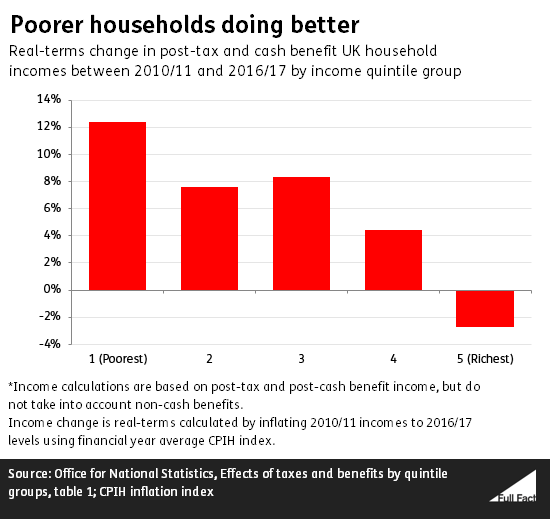
Simple measurements of money spent don't show the whole picture (as the article discusses). Many of the harshest cuts were against services for the poor, while other expenses (military, pension support for richer citizens) saw raises in spending above inflation.
This report is so horribly biased. The "austerity" in question is a decline in spending as a proportion of GDP since 2009, NOT actual cuts. That's normal when recovering from a recession!
And what do you do when coming out of a recession? Reduce spending or hold steady in absolute terms... Like what the British budget has done since the spending peak in the middle of the recession.
A recession means that not enough money is spent in the economy.
In that situation, a government should increase the spending, not use the situation as an excuse for cutting the public sector because ideological reasons.
Or do you think that the intention is to restore those services when the economy goes better?
We're ten years from the start of the last recession. Should spending still be high to stimulate the economy, or are they perhaps not in a recession anymore? This isn't a case of a government reducing spending in response to an economic downturn. It's a government INCREASING spending due to that downturn, and then not further increasing it when the economy recovers.
The UK is one of the richest countries in the world. Part of the reason for that is a long period of generally pro-business, economically conservative government. That's good in many ways, because in a modern economy, business and investment is needed to drive improvements in individual living standards.
But doing that relies on a sensible long-term strategy that can be used to achieve social goals. There is no point in cutting healthcare spending for preventative services, for example, if those cuts result in higher long-term costs. Cutting spending on disability benefits doesn't magically save money – it just transfers the cost of disability support to charities and carers, while in many cases destroying the lives of people who have worked and contributed for many years.
The thing is, when you say "a little belt tightening", this actually means that people in the UK with the lowest incomes start to suffer and in some cases die. I struggle to believe that it is good long-term economic policy to have a large share of the population struggling to afford basic essentials, while the richest demographics continue to increase their wealth.
In the most recent UK budget, I received a large tax cut despite being a relatively high earner. Indeed, UK policy seems to be continuing to shift in that direction, and the only possible reason I can see for that is a deliberate, ideological attempt to enact a policy of minimal public spending.
The UK has many economic and structural problems which could be dealt with, but it's hard to see how continuing to redistribute wealth to the richest parts of the country is going to do that. And of course we now have an entire government that will be paralysed by the economic and political aspects of Brexit for the next decade, so I guess there's no immediate chance of salvation.
The UK is one of the richest countries in the world.
Yes but you are neglecting to mention the other side of this coin: also one of the most expensive countries in the world. Look at purchasing power parity and the UK doesn’t seem rich at all, it’s all on paper only. Housing, fuel, transportation etc are all disproportionately expensive here.
Okay, sure – if you rank by per-capita PPP then the UK slides down the chart further than you might expect. That doesn't in any way make it a poor country or change the point at all.
Well, it sort of does: any services the government delivers will be delivered by people being paid UK wages using goods and services paid for at UK prices. We look rich from the outside because we (still) have a strong currency but from the inside the UK is not especially wealthy because you don’t get much for your money here.
"There is no point in cutting healthcare spending for preventative services, for example, if those cuts result in higher long-term costs. "
By that logic the government should simply increase spending 10x on disability and everything will be great!
Everything has an ROI, everything has an efficiency.
Canada and Germany both went through massive austerity in the 1990's to re-tool their economies from massive debt overhang - and it worked. Both Canada and Germany emerged on reasonable footing.
I think arguments should be less about spending and more about efficiencies.
By that logic the government should simply increase spending 10x on disability and everything will be great!
No, you've made a logical leap that isn't warranted.
There is nothing wrong with running a balanced and cautious budget, and I didn't say there was. But cutting spending on a service unnecessarily, when doing so raises the total long-term spending on that service is categorically inefficient. It's a classic example of short-termism – government ends up simultaneously forking over more money, and achieving less!
Everything has an ROI, everything has an efficiency.
Yes, I agree. That's why UK government austerity should focus less on inefficient spending cuts to essential services, and more on restructuring the economy.
Increased spending on disability (eg, on providing adapted cars or lower cost transport to disabled people) reduces future spending because it gets disabled people back into work and work is generally protective of health.
> Germany both went through massive austerity in the 1990's to re-tool their economies from massive debt overhang - and it worked.
AFAIK, for Germany that was mostly consequences of reunification. Economic growth slowed in the early 2000s and the centre left instituted the Harz benefit reforms etc. They certainly didn't pay down goverment debt in the 1990s: https://tradingeconomics.com/germany/government-debt-to-gdp
> The UK is one of the richest countries in the world.
There are two parts to England: London and not London. All the money is centered in the capital and the rest of the country is neglected. House prices in London are driven up to insane levels due to the money laundering through real estate transactions for empty housing.
The majority of the working class people in England live in poverty.
That's a fascinating definition of poverty. It's certainly not an internationally recognised one. Have you ever been to England? People in Birmingham or Manchester are certainly not living in poverty by any reasonable definition of the term.
You try telling that to all those people on zero hours contracts who can even make a living wage. England is inherently working class and they are poor, most living pay cheque to pay cheque.
it's a real shame that the concept of raising certain taxes in the UK (specifically income tax and corporation tax) has become an anathema to british politicians.
We still need to get the money from somewhere, so instead of fairly increasing progressive taxes, we get lots of little (often unfair) hidden tax rises and huge cuts in public spending.
The weird part is, the british public go along with this. The Conservatives are actively talking about more corporation tax cuts at a time where we still have a large defecit and huge problems with underspending in the public sector.
> The weird part is, the British public go along with this.
I don't think they're 'going along with it' - you're making it sound like they don't know what they want.
UK society doesn't have much of an anti-government movement like in the US, but low taxation and leaner governance is a pretty common, mainstream preference here. I think if you speak to a diverse group of voters in the UK you will find a lot of support for austerity and low taxation.
It's not even a Conservative thing! See my sibling comment for an example.
The NHS is a strong outlier in people's preference for extra funding. Child education is another. But for social security? I think the appetite in the UK is less than you think it is.
Well I'd argue they don't know what they want really, in that they want two divergent things, "better public services" and "low taxation"
Personally I didn't mention Social security, I know the attitude to people claiming benefits from those not on them in the UK
I was thinking of the problems in local gov. spending where the central grant has radically decreased, the problems in police spending with far fewer front line officers, the problem in the courts system which is having major impacts there.
The bit about "going along with it" was primarily about the corporation tax cuts.
Those cut revenue and don't directly help citizens (unless you believe in trickle down economics!). A more rational approach would be to want lower personal taxes surely?
> in that they want two divergent things, "better public services" and "low taxation"
They think this can be achieved be being more efficient (all the newspaper articles about NHS wastage and middle managers), and spending less money on things they don't want (overseas aid is a common example.) So the two things aren't necessarily at odds.
> unless you believe in trickle down economics!
I think a lot of people do.
> A more rational approach would be to want lower personal taxes surely?
I think a lot of British people see a large successful business as a virtuous success story, and so want them 'punished' less with less taxes.
(I'm not saying any of this is my opinion, but it's definitely what a lot of people here think.)
I'm not sure about the successful business piece. Look at the protests over tax dodging by companies.
I'd say that kind of attitude is common in the US, but less so in the UK.
Albeit I'm seeing things from a Scottish rather than English perspective, but I've not seen an appetite for lower company taxes..
My guess for continued support of this kind of policy is that people think other things are more important (e.g. brexit) + tribalism in voting habits (we've always voted that way round here) + of course the terminally broken FPTP voting system.
Company taxes are being lowered because last time that was done, tax take went up not down. That is lower corporation tax = more tax revenue and it's revenue that matters.
for the UK? you got a citation for lower rates == increased revenue?
the only close example I can think of in the UK is the higher rate income tax band bit and that turned out to be clever accountants banking on the fact that a change in gov. would lower the rate so they time shifted income into the period where it was lower...
My local (Labour, not that it really matters) council has taken pride in not raising council tax for the last 5+ years. Yet inflation has pushed up wages and expenses and somehow they expect to maintain the same quality of local government. Impossible!
That's a valid objection, though I think council tax is a particularly tricky issue to deal with in the UK – it's a highly regressive tax, but reform is difficult to achieve while the people who would be most affected by a proper reform would be Conservative voters.
I'm so sick of receiving tax cuts I don't need and will literally never notice, alongside cuts to public services that some people really really need being cut, that the Tory party will never win my vote.
Well, I say never; never is a long time, but as long as they keep trying to win my favour by cutting my taxes, they can get bent. I'm not some kind of Pavlovian econo-rational robot, and I object to them treating me as one. These days I tend to vote for the most crazy left-wing party on the ballot, but if there isn't one (there's usually one in local elections, isn't one in nationals), not bother.
I will pay hundreds of pounds less tax in the next tax year. It seems like an absolutely pointless tax cut. It will make essentially no difference to my quality of life. In the meantime, local services that I use are deteriorating – let alone the ones that people in much more need than I use – and the police force and health service are continuing to head towards an absolute meltdown. There are thousands of people in my local council area relying on charity-run food banks. It's a baffling state of affairs.
Another +1 for me on that. I'd happily forgoe the tax cut I'm getting this year for better public services.
This myth that gets rolled out that any increase in tax will cause higher rate payers to flee the country in droves is really harmful, I'm happy to pay tax if it improves the services provided by the country.
Private health in the UK can only exist off the back of the NHS.
The doctors are mostly trained in the NHS system. When a surgery happens there's a reasonable chance that it's in the private floor of an NHS hospital, using a private doctor but the rest of the team is NHS. You'll get a private room. But if anything goes wrong, or if you need more after care, you'll be back in the NHS system.
In the UK private health care is at best queue-jumping, but at worst it's poor quality care from doctors who couldn't keep a job in the NHS.
That's a really inefficient way to fund health care. A well run centralized system has massively better buying power and no requirement to provide ever increasing profit margins to shareholders.
I'd prefer my money went to a central budget and was used effectively at a country level :)
Can I also have everyone else in the same boat as me also donate the money they don't need? My few hundred pounds is not going to go far. I don't want them to take just my few hundred pounds. I want them to take in hundreds of millions of extra pounds.
I don't want charities having to rescue people from defunded services that were defunded to give money to people who will never notice it; I want the government to come up with better policies than "let's just cut some more taxes for people who don't need it and won't even notice".
You may feel you don't need tax cuts or won't notice, but don't speak for everyone. You're really just taking the standard position of "I wish the government would take other people's money but I'll phrase it in an odd way, so I can feel virtuous".
The Inland Revenue does accept overpayments. You could give yourself a tax rise and be the change you wish to see in the world. If you don't then it seems like you're not being entirely straight-laced.
Aside from how terrible this kind of "there are worse things elsewhere" argument is in general, this isn't even a choice. Like, a little belt tightening trashed the Greek economy. Utterly wrecked it. Did more damage and for longer than the 2008 global financial crisis.
Economy is in a recession. Austerity means that the government is spending _even less_ into the economy.
How do you think that makes the cliff less high?
Not bailing out the banks during 2008 would have been austerity. It would also have made things probably twice as bad (2008 was bad, but the 30s were way worse, like 30% unemployment bad)
There is no actual logical path between austerity and improved short or midterm economic performance. It’s feel good politics, simple and easy to understand but also plain wrong
> ... government is spending _even less_ into the economy.
Where do they get that money to spend?
Money spent by individuals and companies is usually better spent than that by the government. (given a law-abiding high trust society)
Money that passes through government is not magically imbued with some extra quality. More the opposite. Remember that story about it being cheaper to hire a taxi than go by train for two or passengers in Greece? That the Greek train system had more employees than passengers and lost a billion per year?
Of course I don't want to go overboard here; money spent wisely by the government on the public good can be more effectively (productively) than the individual or company.
Austerity stunts growth - it's only a short-term solution.
In your analogy, it only pushed the cliff further away. The cliff is still there, it's still as steep and still as high and we will still, inevitably, fall off it and suffer the consequences.
"We" (I'm Greek) as in those of us who haven't yet crashed- haven't yet been rendered homeless, or forced to live hand-to-mouth, supported by soup kitchens and community handouts and so on.
Austerity increases economic growth. Government spending isn't "growth" because it's funded by taxation - unless it's funded by borrowing, in which case it's only a temporary growth spike that must be offset by contraction later, as tax revenues are diverted into repayments and interest. In the long run all growth comes from the private sector.
In other words you're saying the exact opposite of what conventional economics says here - massive levels of borrow and spend is exactly why the Greek economy is so bad, and austerity on an equally massive scale is the only long term solution. When the Greek state is a smaller proportion of the economy, actual growth can occur.
BTW it'd be great if Diomidis Spinellis could comment on this.
Someone who has won IOCCC four times and who was the General Secretary of Information Systems at the Greek Ministry of Finance has got to be worth listening to.
Greece had the alternative of dropping out of the Euro and defaulting on their debts but even Syriza, a left wing party, when faced with that prospect, balked.
Greece's fate was sealed when they joined the Euro and started borrowing huge amounts of money that they could never repay, whilst also not carrying out structural reforms to improve tax receipts (like reducing some of the tax evasion in the country)
Their government appears to have decided that this path is "least bad". Not sure that I'd agree but I'm not in Greece to see the options first hand.
Edit: as I'm getting downvotes, I'll provide references :)
Greece was free to leave the Eurozone, issue its own currency and start spinning the printers to do as much public spending as they want. But they chose to stay within the Eurozone and it would be immoral and wrong to ask citizens of other countries to fund their out of control public spending.
But it's the same belt for all three? I find it both fascinating and unsettling that there seem to be so many smart people that prefer and defends punitive action so reflexively that they will go to great lengths to give it the benefit of the doubt, even without ever doing some background research.
Austerity is a great example of this. They intentionally starved the Greek economy to make a political point rather than produce an economically rational deal. Yet, at every anecdata like, HN, The office lunch table, etc. too many assume with confidence they have only themselves to blame and parrot obvious propaganda about the lazy, barely working, tax-dodging Greeks that's applied to them all, bottom-up.
Austerity is not 'punitive', nor is your assessment of the OP's comment as 'reflective' necessarily correct.
"They intentionally starved the Greek economy to make a political point"
Greeks are smart people, that they are begging for free money from Germany does not mean that Germany is 'starving' anyone.
"parrot obvious propaganda about the lazy, barely working, tax-dodging Greeks that's applied to them all, bottom-up."
It's not propaganda - or at least not the 'non tax paying' part.
Not only does Greece not have a functional tax system, they also demand to retire earlier with full benefits than workers in other nations.
The Greeks have nobody to blame but themselves.
Also when you say 'do a deal' what you mean is 'give Greece more free money' - i.e. throw good money after bad.
The Germans would in fact, do a deal with the Greeks if they instituted proper economic reforms, by the way, which would not necessarily have to include austerity, but would definitely have to include reform of the tax system, possibly tourism industry etc. etc..
But Greece cannot do that, they are not functional enough to pull it off.
The easiest option would be simply to devalue their currency, which they cannot do ... which might give you a clue as to the real source of economic Imperialism that is the Eurozone.
Countries that cannot keep their books straight for whatever reason, but are otherwise functional, may have an intrinsic need to devalue their currency. It might be the best way for them to move forward - but the EU does not allow for that ...
... so maybe the Eurozone should be more of a 'trade zone' and less of a currency/political union, as so many people would like.
Thanks for confirming my point so well. It's lovely how bottom-up democratic everything becomes as soon as blame and punishment are being thrown about.
> The Germans would in fact, do a deal with the Greeks if they instituted proper economic reforms
What do you think austerity is if not widespread drastic "reforms" among other things? The Greeks did go to great lengths to appease the eurogroup but still needed a fundamental debt trimming.
Really? There's some objective reality now in economics and politics? To add insult to injury you also imply that they just haven't been bothered yet to simply fix themselves? I'm sorry, but that's a pathetic reply.
Why is it pathetic? It does reflect a very real reality. And yes there are "objective realities" in economics and politics and always have been. In economics the objective reality is resource limits. In politics, votes.
Have you ever investigated the Greek situation? The country is a basket case of epic proportions. The best description I ever saw of it is "a third world country temporarily able to pretend it's not due to the EU".
Tax collection has already been mentioned. There are many other problems. For instance in most countries workers retire at 65. In theory so do Greeks. But not in practice: Greece has the notion of a "arduous and unhealthy job" which lets you retire at 50. Some of the jobs considered so bad you can retire a decade or more early, on a full pension, include trombonist, bakers, masseuses, hairdressers (this job also qualifies as dangerous!), and pastry chefs.
The notion that Greeks are hard working is systematically undermined by facts about their own laws. The country lived off borrowed money for many years, and is now being brought back to something resembling the correct level of wealth given their laws and economic fundamentals.
To write a good reply to this would take some time and effort that I'm not willing to spend on someone with the comment history you have I'm afraid. The common best case scenario seem to be that you just stop replying.
I might give this argument a little more credence had the ”little belt tightening” measures not been so transparently politically motivated wealth transfers from the poor to the rich. Funny how ”belt tightening” always applies to the least powerful.
I know that the 'borrowing off the next generation' is a popular sentence, but, does that means anything at all?
Would you prefer to live in a country with a high public debt and industry, infrastructure and an educated population or in a dessert with zero public debt?
What even means the 'public debt' number when a country have its own currency and inflation is under control? Nothing at all.
> What even means the 'public debt' number when a country have its own currency and inflation is under control?
This is a question that you have to ask when using the analogy between a country's finances and e.g. a household. It _can_ mean that one part of the country (government, central banks) has created and loaned money to _other parts of the same country_. In other words, liquidity and investment. i.e. good things! This is fundamentally unlike a household.
Productivity is not just a function of investment.
Spain doesn't form large organizations like they do in Germany and the UK. More people in Germany for example are employed in large organizations wherein they can create more sophisticated products like cars.
Do they have extensive coop/internship programs for young people to work at large organizations?
Is the civil service actually productive?
My experience with our own Spanish office is that they are slack. I would say professionally disorganized. They'd probably just accuse me of bad 'life work balance' , which is fine. But the office hours, long lunches, absenteeism ... nobody really ever seemed to be doing anything. And FYI the work days were long .... Now that is anecdotal - my personal experience, I know that a lot of places hum along obvious, but most of my Spanish friends would concur with what I'm saying though probably not my language. Call it weather, culture, whatever but there's a different culture outlook and this cannot be ignored.
Here's a good take that matched my sentiment [1]
The problem with this 'investment' argument as it relates to Greece, Spain etc. is that only systems that are prepared for investment can possibly make good with it.
Think of a company like a startup: should every startup receive $100M - would that make everyone successful? No - because most startups don't have 'product market fit' and they are not creating value. If a nation has the wherewithal and are ready for investment, well that's another thing. And of course consider how that capital is distributed ... by governments often to their civil servants and pensioners, which might be good, but it's also not exactly going to result in any kind of industrial development.
Sweden, France and Germany aren't valid comparisons because they weren't affected by the financial crisis like we were. In fact you could argue Germany has benefited from the problems of the problem economies because they have kept the Euro weak.
Considering that the youth unemployment rates there correlate with policies that didn't just involve "tightening" the belt but arguably cutting off all circulation, you might want to re-think that.
(much of Europe has been victimized by the cult of "austerity", and several countries have probably lost an entire generation's productivity thanks to these policies)
>much of Europe has been victimized by the cult of "austerity"
What cult? Capital markets decided that Greece is too risky to lend money to at reasonable rate. Same happened with Spain and Italy, but they were saved by European Central Bank which became a lender of last resort and bought plenty of their bonds, driving interest rate lower.
It's not like Italy and Spain can easily tap capital markets borrowing trillions of euros at 1% interest rate, but decided not to do so because of 'cult of austerity'.
The ECB has printed €2.4 trillion since 2015 and very little of that has gone to Greece, Italy or Spain. The tap was turned off for Greece by the EU when they refused to help them with debt (mostly owed to German banks) - this was a political decision, as was that to impose stringent austerity on Greece, on people who could not afford it (pensioners etc). It didn't have to happen that way, it was a deliberate choice.
This had nothing to do with free markets (which really are not very free, they are massively impacted by central bank actions).
> to impose stringent austerity on Greece, on people who could not afford it (pensioners etc)
So, if they can't afford austerity what makes you think they will repay debts in the future?
"Pensioners" yes, usually from an inflated public sector. Untouchables. Who pays the price? The youth
What about passing needed reforms? LOL, of course not, that will hurt the inflated public sector and their pensioners, never mind no one wants to invest there anymore.
And the worse thing is, if you turn the tap on, you'll probably get the lovely results of "Abenomics", that is, people investing in BS like (existing or low demand) real estate or on non efficiency improving activities (like buying old computer parts for old systems)
Before the "evil" ECB that lends with few guarantees those countries were paying the real cost of their debts (incl. currency devaluation) But then it was "Evil Germany" that could borrow with low interest rates while they had to pay high rates.
There are no easy solutions here, but it's simplistic and wrong (morally and objectively) to claim that the people of Greece deserve the destitution imposed by the EU. I say this as a supporter of the EU project who thinks this was a very dangerous and counterproductive move for the EU.
Did the cleaners at the finance ministry deserve to be fired because of arbitrary austerity? Does a grandmother in Athens who worked and paid into a pension all her life deserve a cut in her pension from €1300 to €600 a month? Does the widow of ansailor deserve cuts from €1900 to €650 a month because of a financial crisis far away?
These are real and serious questions.
The worst part of this policy of austerity is that the only thing it is useful for is imposing subjugation on the politicians of Greece, it makes Greece unable to pay for its obligations and unable to recover from them. I agree Greece needs reform, needs to collect more tax, needs more jobs and industry, but pro-cyclical austerity is not the answer for anyone including the debtors of Greece.
This shouldn't be about winners and losers, and fairy tales about evil Germany or corrupt, feckless Greece - it should be about getting Greece back on its feet so it can contribute. The same way the EU helped Spain after Franco or Ireland after the troubles.
> to claim that the people of Greece deserve the destitution imposed by the EU
Destitution was not "imposed" to them. While I agree there are issues with the Euro zone/lack of a fiscal union, the end problem is lack of money going in. That shows up as austerity in this case BUT would have shown up as devaluations/debt/inflation in other cases. Coming from a 3rd world country I can say I have experience in this unfortunately (then the "evil guys" are the IMF, etc).
> Did the cleaners at the finance ministry deserve to be fired because of arbitrary austerity? Does a grandmother in Athens who worked and paid into a pension all her life deserve a cut in her pension from €1300 to €600 a month? Does the widow of ansailor deserve cuts from €1900 to €650 a month because of a financial crisis far away?
It's not "fair", and some of those issues are just a fundamental lack of jobs/work (same thing happens anywhere) but the issue is not with them. However it's easier to cut salaries/earnings of those people in your example while keeping the privileges of the higher levels. (See for example faculty/administration wage gap in American universities)
> it should be about getting Greece back on its feet so it can contribute. The same way the EU helped Spain after Franco or Ireland after the troubles.
Agreed, and austerity is not good in itself, it's more like making a fat person starve (which sucks and everybody hates) instead of making them eat better and exercise more (but if they don't do it themselves, then what).
I'd contend it absolutely was, this is why I gave examples of measures imposed by the troika like firing cleaners.
Austerity is the wrong solution at the wrong time and is especially galling given the central bank's largesse to other sectors/countries at the same time.
They should have imposed a large haircut on creditors and given long term loans to Greece, instead they imposed drastic budget cuts (aka destitution for the people of Greece) and sold it as justice. It was unfair, cruel, and fundamentally wrong.
Nothing stops Greek government from defaulting. Just miss your next coupon payment, and viola.
But once you default, you have to balance your budget, because nobody will lend to you, and until 2017 Greece were running a deficit. Default would cause even more pain than so much hated austerity.
"Victimized by 'austerity'" is heavily overplayed. Even with 'austerity' policies, government spending in Greece is still around 50% of national income. Neither their own citizens (via taxes) nor foreigners (via lending) are willing to finance such spending, so what alternatives to decreasing spending would you suggest?
Isn't it weird how austerity often targets the poor, while e.g. salaries of bureaucrats or politicians, as well as military and police spending are rarely part of these strategies.
One can discuss about austerity as an effective strategy to slim-fit a nation. Making the government and public processes more effective, streamlined and effective, using less manpower to reach the same goal and increasing the efficency, speed and simplicity at the same time – this is a good goal. BUT this is definitly not what usually happens when governments say they need to save money, because those who know how to make the processes more efficient usually don't like to cut their own jobs/salaries/responsibilities.
So they just cut some public service that affects nobody meaning-/powerful instead and sell it as a big reform.
Wonder how long before he is sacked. Rare instance of establishment official bucking the narrative. These kind of reports are usually made about 'inconvenient regimes'.
Austerity [1] is a dubious predatory ideology pushed by neoliberal economists parroting the mantra of freemarkets, privatization while pushing crude policies that benefit special interests. The modus operandi is defund public services, raise a ruckus about ensuing chaos and build the rationale for privatization.
A country with its own currency is a not a household. In the case of the US the dollar being the global reserve currency provides even more freedom compared to any other country. Simplistic household type comparisons by agenda driven economists about complex modern economies are grossly misleading.
You cannot bailout banks to the tune of trillions and them impose austerity on the population, this is not capitalism or freemarkets, its gross corruption. Where did this money come from? What about all the scares of 'runway inflation' by such massive injections, why were creditors bailed out and not debtors? Why shouldn't these funds be spent on the people the government represent and not special interests?
Mark Blyth [1], Michael Hudson [2], Steve Keen and Joseph Stiglitz [3] are doing a lot of work on neoliberal economics and dubious policies like austerity.


The first problem is measurement. Most current economic measurement methodologies don't consider history well enough - particularly where public funds have been used for infrastructure benefits.
Using the US as an example, the modern status quo of life is built upon the interstate highway system. That's just one (very big) example of how public works/infrastructure has benefited the entire society - especially the business owners who can be more efficient due to well-oiled transportation systems. Perhaps some other rail-based system would be even more effective, but that's beside the point.
But as humans are wont to forget the past, many people have forgotten that it took bold investment at a time when money was scarce to provide a foundation for the next 40+ years. So the fairly recent proclamations of small business owners that they built their own fortunes conveniently forgets that the entire population's investment some decades ago primed the situation that they find themselves in now.
Austerity says the reverse: we will not spend anything on anyone out of public funds (unless some powerful group deems it necessary... such as where military is concerned). But what it fails to recognize is that the more people you have dying around you, the lower your health becomes.
Ignoring ethical discussions, there are practical boundaries to questions of "how much is enough" for people on the upper end and "what is the minimum to live a better-than-horrible life" on the bottom end.
I do not enjoy paying practically double the tax rate in Netherlands as I did in the US, but I find daily life SO much better (and safer) here. Being a king of a ghetto is no life. I'd rather the people cooking my food and washing my dishes at the restaurant not be hating my existence because they're so miserable. In fact, I'd rather them feel essentially equal so that when I compliment them on the food or service they feel pleased to have a conversation with me. That is living.